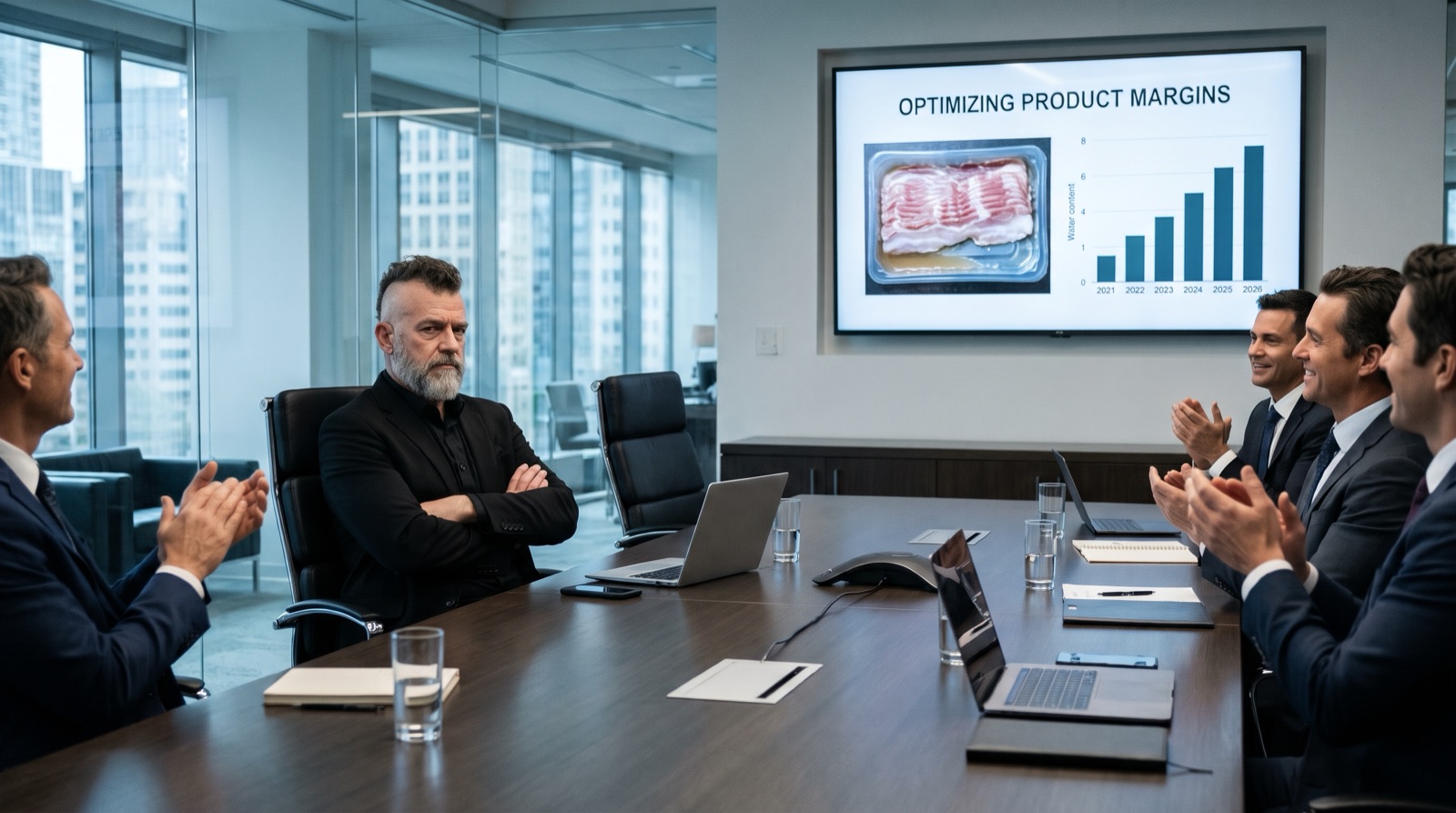
My bacon is watery. Throw it in the pan and it doesn’t sizzle, it sits there in a puddle of milky grey liquid, boiling. By the time the water has evaporated and the bacon finally starts frying, it has perceptibly shrunk.
It’s getting worse. I’ve been buying the same bacon from the same supermarket for years, and every year there’s more water in the pan. I’m not imagining it. I’ve started unpackaging the bacon, peeling it apart and storing it in a container in the fridge, so it has a chance to dry out a bit before I cook it. Bacon isn’t supposed to be like this.
This isn’t a bacon problem, really. It’s a symptom of how late-stage capitalism works. It’s what happens when a mature company selling a mature product is still required to grow.
Bacon is a mature product
There is not much innovation left in bacon. It’s pig, cured and smoked. People have been doing it for a very long time and they got it right a couple of centuries ago.
The market for bacon is also mature. The same people who liked bacon last year like bacon this year. They eat about the same amount of it. Probably less because of all those pesky doctors telling us to eat less red meat.
So if you’re a supermarket selling bacon, how do you make more money from bacon this year than you did last year? There are only a few options:
- Sell to more people. Take customers from your competitors.
- Pay less for it. Squeeze your suppliers.
- Charge more for it. Put the price up.
- Put less bacon in the bacon. Add water to your bacon.
The supermarket I buy my bacon from is half of the Colesworth duopoly. Coles and Woolworths have about two-thirds of the Australian grocery market between them, according to the ACCC’s supermarket inquiry. There’s no more market share to take. The two companies are a cartel, everyone knows it, and they purposefully don’t compete too hard with each other. Everyone who’s going to shop at Colesworth already does, and the ones who shop at IGA aren’t moving.
They’ve already squeezed the supply chain, all the way from the pig farmers to the delivery drivers, as hard as it will go. Ask any farmer in Australia how they feel about the duopoly and you’ll get a sweary rant in response. They can’t squeeze any more savings out of the supply chain.
Prices have already gone up, a lot, and there was a whole Senate inquiry and a lot of angry press about it. There’s a limit to how often they can do that before the government gets involved again.
Which leaves option 4. Water is cheaper than bacon. Pump more water into the bacon, sell it by weight, and the same pig makes more money. Next year, they’ll add more. Because there’s no other way of growing profit.
Why does it have to grow?
This is the bit that gets me. Why can’t the supermarket just… not grow? Sell the same amount of bacon at the same quality for the same margin, make a healthy, stable profit, and pay that out to the shareholders as a dividend?
Because that’s not why the shareholders bought the shares.
Most people don’t buy shares just for the dividend. Even in Australia, where dividends are more valued, what moves the share price is whether investors expect it to go up. People buy shares because they expect the price to rise. They buy now, hold for a year or so, sell for more than they paid, and pocket the difference (any dividend is a nice bonus).
And the share price only goes up if the market expects the company to make more money next year than it did this year. A company that makes exactly the same profit every year is worth exactly the same every year. Its shares are a savings account with extra risk. They don’t grow in value, so you can’t make speculative profits from just owning them, so their price goes down relative to other shares.
Management have to create growth. Their bonuses depend on it, their share options depend on it, their jobs depend on it. A CEO who stands up at the AGM and says “we sold the same amount of bacon as last year, at the same quality, and made the same profit” gets fired, even though that is a perfectly good result for a mature company in a mature market.
Which means growth at any cost. And when all the honest ways of growing are used up, the only ones left are the dishonest ones.
This is enshittification
Cory Doctorow coined “enshittification” to describe what happens to online platforms: first they’re good to their users, then they abuse their users to make things better for their business customers, then they abuse their business customers to claw back all the value for themselves. Then they die. The Macquarie Dictionary made it word of the year in 2024, which tells you how many people recognised it.
Doctorow was talking about Facebook and Amazon, but my bacon is going through exactly the same process. The product was good, it got the customers, the customers got locked in (where else am I going to buy bacon? Aldi, maybe, and they’ll get there too), and now the product is being steadily degraded to squeeze out more money.
You can see it everywhere once you start looking. Shrinkflation: the same price for a smaller chocolate bar. Streaming services that add ads to the tier you’re already paying for. Software that used to be a one-off purchase and is now a subscription. Airlines charging for seat selection. Every one of them is a mature business that has run out of honest ways to grow, and the share price still has to go up.
None of these companies are run by cartoon villains. I am not criticising the people who work there. Most of the managers making these decisions would probably prefer to sell good bacon. But they’re in a system that punishes them if they do, and rewards them if they don’t.
The shareholders aren’t the villains either. They’re mostly fund managers who have to provide the best returns to their clients. They don’t make decisions about watery bacon. They just see that a growth stock might return a few hundred basis points more than a steady dividend payer. So they push for growth. That’s just their job. Holding a share for twenty years doesn’t make you any less keen on the price going up every one of those years.
This isn’t how it was supposed to work
The whole point of selling shares in a company was to raise money to do something big that one person couldn’t fund alone. Build a railway, send a ship to the spice islands, open a factory. You put your money in, and in return you got a share of the profits. The profits came to you as dividends. That was the deal.
The share price going up was a side effect. If the company was doing well and paying good dividends, the shares were worth more, because the dividends were worth more. You could sell them for a profit if you needed the cash, but that wasn’t why you bought them.
Somewhere along the way, that flipped. Milton Friedman wrote in 1970 that the only social responsibility of business is to increase its profits, and a generation of executives took him at his word. In 1982 the US gave companies a legal safe harbour for buying back their own shares, something that until then risked being treated as market manipulation. So companies could return cash to shareholders by pumping up the share price instead of paying dividends. Executives started getting paid in share options, which only pay out if the price goes up. Australia went the same way, a bit later and a bit less enthusiastically, but we followed. America’s Poodle again.
Now the share price isn’t a side effect. It’s the product. The company exists to make the share price go up. Selling bacon is completely incidental to that. The CEO doesn’t wander around the store looking at the bacon and saying to the team “why is this so watery? Let’s fix that and make our customers happy!”, they look at the share price and tell their team to make number go up.
And because the share price is supposed to reflect what the company will earn in the future, it reacts to promises as much as to results. In theory that’s how it’s meant to work: the price is everyone’s best guess at all the profits the company will ever make. In practice it’s got ridiculous. A CEO announces the company is going to build data centres on Mars, and the share price jumps that afternoon, before anyone has bought a single rocket. Nothing has been built. Nothing has been sold. The only thing that’s changed is the story.
Sharp operators know this, and use it. Say something exciting, watch the price go up, sell. In 2017 a company called Long Island Iced Tea renamed itself Long Blockchain, without any actual blockchain business, and its shares nearly tripled in a day. In 2018 Elon Musk tweeted that he had “funding secured” to take Tesla private at $420 a share. He didn’t, and the SEC fined him and Tesla $20 million each. This is the same man who promised a million Tesla robotaxis on the road by 2020. Those are the ones who got caught. I’d bet plenty more do it carefully enough to stay on the right side of the law, and make a lot of money without making anything at all.
And we tax it less. If you hold an asset for more than twelve months, you only pay tax on half the capital gain. Earn $100,000 working a job and you pay tax on all of it. Earn $100,000 from buying shares and selling them thirteen months later, and you pay tax on $50,000. The tax system actively rewards putting water in my bacon and making everything worse.
Nothing resets it any more
Historically, something came along every generation or so and reset everyone’s expectations. Usually a war. Sometimes a depression, a pandemic, or a revolution. Walter Scheidel’s The Great Leveler argues that these are pretty much the only things that have ever wiped out accumulated wealth and reset inequality, all the way back to the Stone Age. Factories get bombed, currencies collapse, fortunes vanish, and everyone starts again from a much lower base. Growing from a low base is easy.
We haven’t had one of those for a long time. There hasn’t been a world war since 1945. We’ve had crises, sure: the oil shocks, the dot-com crash, the GFC, COVID. But every time, governments and central banks stepped in and propped up asset prices, and the share market went straight back to expecting growth like nothing had happened. Australia went nearly thirty years without a recession, from 1991 to 2020. So we’ve had eighty years of growth expectations stacking up on top of each other, with nothing to reset them.
I’m obviously not suggesting we need a war. But we need some way of resetting growth expectations peacefully, and I think taxing speculative profits is a good place to start.
Tax speculative profits
So I suggest we tax speculative profits. Properly, possibly even punitively.
If the problem is that people buy shares to profit from the price going up rather than to share in the profits of the business, then make the first one less attractive and the second one more attractive. Some ideas, very much a quick brain-dump rather than a policy paper:
- Scrap the capital gains discount for shares. Capital gains get taxed like income, the same as everyone else’s wages. That alone would change the maths a lot.
- Go further and tax short-term gains at a higher rate. Sell within a year, pay a big premium. Within five years, a smaller premium. The longer you hold, the closer you get to the normal rate. If you’re actually invested in the company, you’ll be holding for a long time anyway.
- Leave dividends alone, or tax them more lightly. We already stop dividends from being taxed twice: dividends are paid out of taxed profits, and come with a tax credit. We could make this even more attractive, so dividends are taxed even lower.
- Treat buybacks as what they are. A buyback is a dividend dressed up as share price growth. Tax it like one. Or ban them.
- Stop paying executives in share options. Pay them on long-term measures that have something to do with running the business well. Like, say, whether the bacon is any good.
I also think we could separate speculative gains from other capital gains, though this might get tricky. There’s a huge difference (to me, anyway) between buying some shares, doing nothing with them, and selling them a year later, and (for example) founding a company, building it up for ten years, and then selling it. But the tax system starts from the position that these are the same thing: a capital gain. There are some exemptions for small business owners, but they come with conditions (own it for fifteen years, be over 55, retire) and they’re exceptions to the rule, not a different rule. Without them, decades of hard graft building a business gets treated exactly the same as owning some shares while everyone else does the work. I don’t think these are the same thing.
And it’s not only shares. Crypto has grown as an entire industry, soaking up vast amounts of available capital that could have been used for productive purposes. But crypto doesn’t produce anything. It doesn’t make profits, it doesn’t pay dividends, it doesn’t do anything except go up or down in price. So every single dollar anyone has ever cashed out of crypto was put in by someone else. Once you take out the fees and the electricity bill, the whole industry is worse than zero-sum: it’s a machine for moving money from late buyers to early ones, and burning some of it along the way. This is speculation at its worst: literally burning the planet to produce nothing, in order to take other people’s money.
The housing market is the same story. The standard investor play is to buy a property, rent it out at a loss, claim that loss against your income tax (negative gearing), and wait for the price to go up, at which point you pay tax on half the gain. The rent doesn’t matter. The tenant doesn’t matter. The state of the property doesn’t matter. Only the capital gain matters. So houses get treated like bacon: apartments get built as cheaply as possible (more than half the NSW apartment buildings in a 2023 government survey had serious defects), rentals don’t get fixed, and the actual purpose of a house, being lived in, becomes incidental. In London it’s gone further, with expensive flats sitting empty for years because they’re worth more as an asset than as a home. Meanwhile there are people sleeping in the streets. All because of speculative gains.
The obvious objections
“But my super is invested in shares!” Mine too, if I had any (decades of underpaid startup jobs and working abroad will do that). I don’t really believe that our politicians are going to leave the super funds alone anyway; there’s just too much money sitting there for them to ignore it. But that’s a separate post. As for this one: super funds hold shares for decades. They’re exactly the kind of long-term owner who’d do fine under a system that rewards holding and dividends.
“But Coles pays out 80–90% of its profit as dividends!” True. Australians are unusual in that we do like dividends. But it doesn’t protect my bacon, for two reasons. First, the tax maths still favours growth: if you’re on the top rate, that dividend is taxed at 45% (less the credit), but a capital gain on shares held for a year is taxed at about half that, thanks to the discount. Second, nobody wants a flat dividend either. The market expects the dividend to go up every year, and a company that pays the same dividend two years running gets punished almost as hard as one whose share price stalls. Either way, the number has to go up. And even if the shareholders were happy with a flat dividend, the executives wouldn’t be. Their pay is in shares. A flat dividend means a flat share price, and a flat share price means a flat bonus.
“Without speculation, how do startups raise money?” I’ve spent a lot of my life around startups, so I take this one seriously. Startups are speculative, and they should be. Investing in a startup is a bet that a small thing will become a big thing, and that’s a legitimate bet to make. The problem isn’t speculating on growth companies. The problem is demanding startup growth from a supermarket. Colesworth are not startups. They’re not going to 10x. They’re going to sell roughly the same amount of bacon every year until the heat death of the universe, and that’s fine. We need to treat growth companies differently from mature ones, and we already have a way to do that. We know what a small business is; it’s defined in law, and small businesses already get different treatment under tax and employment rules. Startups are small businesses. So treat investment in small businesses differently from investment in Coles. Once a startup gets big enough to stop being a small business, it’s stopped being a startup too, and it can be taxed like everyone else.
“Companies will just find another way around it.” Probably. They always do. Any change to the rules creates a new set of incentives, the market will find ways to game them, and we’ll have to adjust the rules again. That’s fine; that’s what tax policy is. Right now the tax system isn’t neutral; it actively favours speculation over ownership. Even getting it back to neutral would help.
“Everything is speculation anyway. Farmers speculate that they can sell their crops for more than it cost to grow them!” No, this isn’t speculation. Farmers produce food. There’s a tangible output that they’re selling. Yes there’s a gamble on the price they can sell at, but that’s not the same thing as just gambling that the price goes up on something with no other input but ownership.
“What about the financial markets? Aren’t derivatives just speculation too?” Yes, and they should be covered by the same tax. There’s a real use for them, farmers locking in a price for their crop before it’s harvested for example, but most of the market is just gambling, and it shouldn’t be this big.
It has to be OK to stop growing
A mature company in a mature market should be allowed to stop growing. It should be allowed to make the same profit every year, sell the same product at the same quality, and pay its owners a fair share of that profit. That’s a good business. That’s what most businesses were, for most of history.
The demand for endless growth from mature businesses that can’t grow is what’s making everything shit. It’s the water in my bacon, the ads on my streaming service, the subscription on my software, the smaller chocolate bar at the same price. And we’re giving it a tax break.
So tax speculative profits. Make working on a business more rewarding than just owning it. And then maybe my bacon will sizzle again.
Sources
- ACCC, Supermarkets Inquiry 2024–25 final report (2025)
- Senate Select Committee on Supermarket Prices, Report (2024)
- Cory Doctorow, “The ‘Enshittification’ of TikTok”, Wired (2023)
- Macquarie Dictionary, Word of the Year 2024
- Milton Friedman, “The Social Responsibility of Business Is to Increase Its Profits”, New York Times Magazine (1970)
- Walter Scheidel, The Great Leveler: Violence and the History of Inequality from the Stone Age to the Twenty-First Century (Princeton University Press, 2017)
- SEC, “Elon Musk Settles SEC Fraud Charges; Tesla Charged With and Resolves Securities Law Charge” (2018)
- Fortune, “Long Island Iced Tea Is Changing Its Name to Long Blockchain” (2017)
- The Drive, “Elon Musk Promised 1 Million Tesla Robotaxis by the End of 2020. Where Are They?”
- Building Commission NSW, Research on serious building defects in NSW strata communities
- SEC, Rule 10b-18 (1982), the safe harbour for share buybacks
- Australian Taxation Office, CGT discount