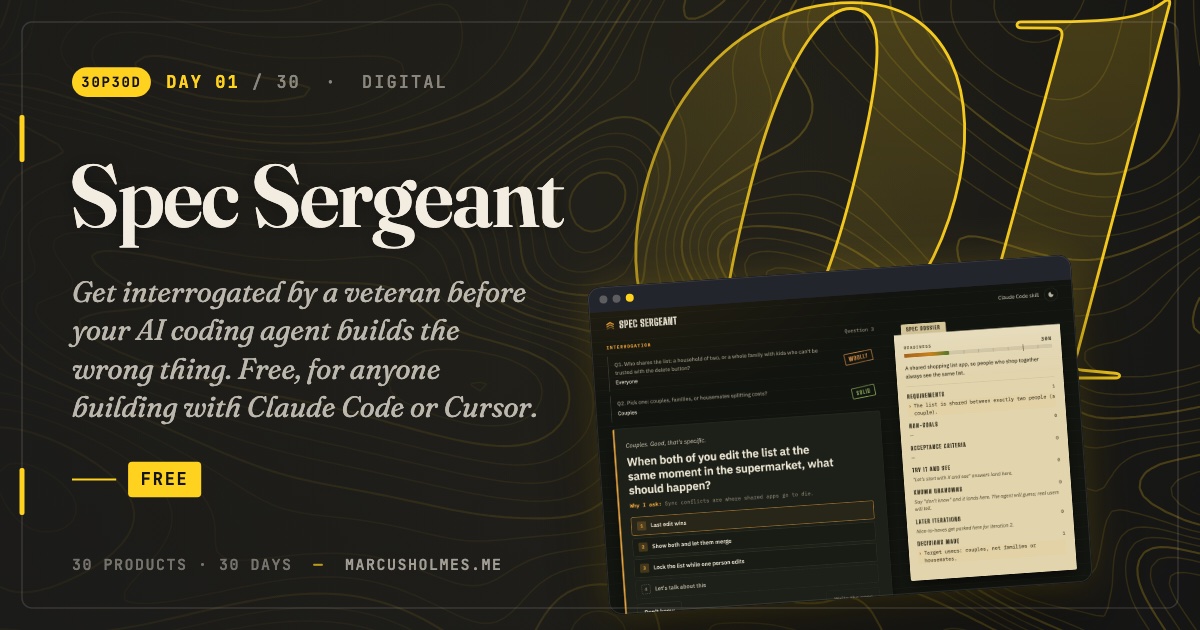
Day 1 of 30 Products in 30 Days is Spec Sergeant. You describe a feature you’re about to hand to an AI coding agent, it asks you the questions an experienced developer would ask, one at a time, and then it writes a spec the agent can build from. It’s free, and there’s a Claude Code skill version if you’d rather stay in the terminal.
Why this one
My first day on 30p30d, so obviously my first task is to set up some tooling for it :)
I set up an ideas.md, and an ideas-rough.md, and added the ideas I had to ideas.md, and got Claude to generate some ideas into ideas-rough.md so I could triage them and iterate on the good ones.
I set up a skill for dealing with the 30p30d site, and set up the rules on deployment and where we’d publish things and how all that would work.
Claude obviously used all of the things I had told it about me to generate ideas. Lots of things about history, about 3D printing, and tech. One of the ideas it came up with was Spec Sergeant. That appealed immediately because I was facing this exact problem: how do I streamline the product creation process so that I can do this once a day easily?
Spec Sergeant is the thing that hones the product idea so it becomes a spec that an agent can work with easily. I plan on using this for the next 29 days.
Building it
Pretty easy. Claude more or less one-shot the first version. I didn’t look at the code, I don’t even know what stack it used, except there’s some TypeScript files in there. I think the first version took about 15 minutes from spec to deployment. I’m used to this now, but every now and again I still pinch myself and remind myself that I’m not dreaming; a fully working first iteration of a complete product, deployed, in 15 minutes. Two years ago that would have been an insane expectation.
Cloudflare hosting is great, their wrangler CLI is great. Smooth as, afaik. You tell me ;)
The first version was an old-school analyst
The interesting part came when I actually used it.
The first version of the Sergeant was a by-the-book requirements analyst. It pinned down everything. At one point I said “let’s cap it at something like 25 for now and see if anyone tries to go over”, and it wouldn’t let it go. It wanted a number. A real number, decided now, before a single user had touched the thing.
It also got stuck on details that don’t matter. Sort orders, exact wording, minor edge cases. Stuff that most people won’t want to spec, and that the agent can make a perfectly reasonable guess at.
One of the things I’ve learned over the decades: we all have opinions about stuff. Most of those opinions are wrong. The only opinion that actually matters is the customer’s opinion. And the only way of finding that out is to put the product in front of them and get them to use it. The key point of iterative development is getting the thing in front of the actual user as soon as possible so you can gather their opinion and make the thing better. And this is soooo much cheaper, easier, and quicker when an AI can churn out a first version in hours (or even minutes).
So we changed it:
- Big stuff firm, small stuff flexible. The Sergeant goes after the things that sink projects (who it’s for, what’s out of scope, data that’s hard to change later, anything that can lose data, money or trust) and leaves the rest to the agent.
- “Let’s try it and see” is a real answer. It goes into a “Try it and see” section: what to start with, and what to watch.
- Known unknowns instead of open questions. The agent makes a sensible guess, marks it in the code, and real use confirms or kills it.
- Every spec is iteration 1. It says what we want to learn from this version, includes a checklist of things for real test users to try and report back on, and sketches what comes next.
It also asks about look and feel because a lot of people find that important (I’m not a visual person, I value words more than pictures, and I’m colourblind so the colours don’t matter), and I have found from experience that if the product doesn’t get that right then some people won’t even try it. I also got it to sketch out deployment options, because otherwise Claude can go down completely the wrong implementation route. And I got it to show multiple-choice questions as buttons, the way Claude Code does, because I found myself re-typing the things that Claude had already asked.
Apart from that, it’s pretty much as Claude first built it.
So, does the experience help?
That’s the question I’m tracking through this whole challenge, and I want to answer it for each day if I can.
Day 1’s answer is yes, but kinda cheating.
This product is literally my experience in an app. So obviously it’s affected by my experience ;) I could not have made it without the experience that it embodies.
I haven’t seen many of the other apps for Day 1 yet, so I don’t know how it compares to theirs. That’ll be interesting. I’ll let you know more on Day 2.
I’m proud of the product, I like it, I think I’ll be using it. Check it out: if you’re about to hand a feature to an agent, give the Sergeant ten minutes first. It’s free.